Followers

Wednesday, 2 February 2011

Machu Picchu

some pics of Machu Picchu

Climbing to the top of Huayna Picchu (the big rocky mountain 
in the clouds) takes well over 2 hours and you have to be pretty fit!
as well as having a real head for heights as the path is often 
only a foot wide - and there is a low tunnel that you have to crawl 
along on your stomach!


The Flame Tree
Reminds me of the White Tree at Minas Tirith 
- but I don´t think JRRT will have seen this.


Tuesday, 1 February 2011

Ruins near Cusco, and the Sacred Valley to the north

In Cusco we visited various old Inca sites in the surrounding area

Huge stone blocks at Saksayhuaman, overlooking
Cusco from the north

Stone terracing at Saksayhuaman. The Inca designed Cusco in the shape of a Puma, one of their gods. Saksayhuaman was the shape of it´s head and the top pic was in a zigzag, representing the Puma´s teeth. The zigzag also represented lightning, one of the most powerful natural forces that they revered.

The huge stone in the centre fell during construction, killing hundreds of workers, so they say.


You can vaguely see the main wall is in a zigzag, the shadowed parts high-light this

A flower!  - probably a member of the potato family,
of which the Peruvians have over 300 varieties


The pics below were from sites in The Sacred Valley (en route to Machu Picchu):


Our guide explaining the religious and ritualistic significance
of this river source. The priests would cleanse themselves here
They must have been tiny - as the 2 small waterfalls directly behind him,
fall into a stone chamber only about 3 feet deep.

a rural view

the national flower - I forget what its called

another site - sacrificial/holy chamber - steps up to stone plinth
on which children were sacrificed

the stone plinth


rural scene

    Inca agricultural terracing

ditto


various flowers

Will put names to some of the places next posting, hopefully with pics of Machu Picchu.

As I had my camera stolen the evening before we went to Machu Picchu, all the pics from now on are from Jane´s pocket camera


Monday, 31 January 2011

Arequipa and the Colca Canyon

Arequipa, meaning the White City, has a lot (not surprisingly) of white
 volcanic rock called sillar which was in abundance here.

Spanish Church - the Iglesia de la Compania - the facade 
is covered in both Christian and Inca holy symbols to help  
integrate the locals into a Catholic acceptance.

Santa Catalina Monastery - the laundry, the only place where the nuns
could gossip. With their hands they diverted  the flow of clean water in
the central gully to fill the huge terracotta bowls, for their washing.


Avocado, I think

Sights in Arequipa

We used Arequipa as a base and for a few days visited the Colca Canyon ..

On route to the Colca Canyon, Alpaca herds. Even at this height of 
about 10,500 feet there were flamingos feeding in the distant wetlands.

There were also some unusual ducks, some with blue bills, and waders. 
Unfortunately those pics were lost


At the Colca pass (below) ...

This is a rare kind of moss, I think only found here at high altitude (16,000 feet). It looks
lovely and soft but is hard as nails. Nigel may be able to remind me of its name :)

same, close up

The summit of the pass to the Colca Canyon
The Canyon is the world´s deepest, more than the Grand Canyon.
It´s popular with people hoping to see and photograph Condors.

Inevitable tack for sale at the summit.

watching out for Condors - we did see and photograph them, 
but again the pics were lost.

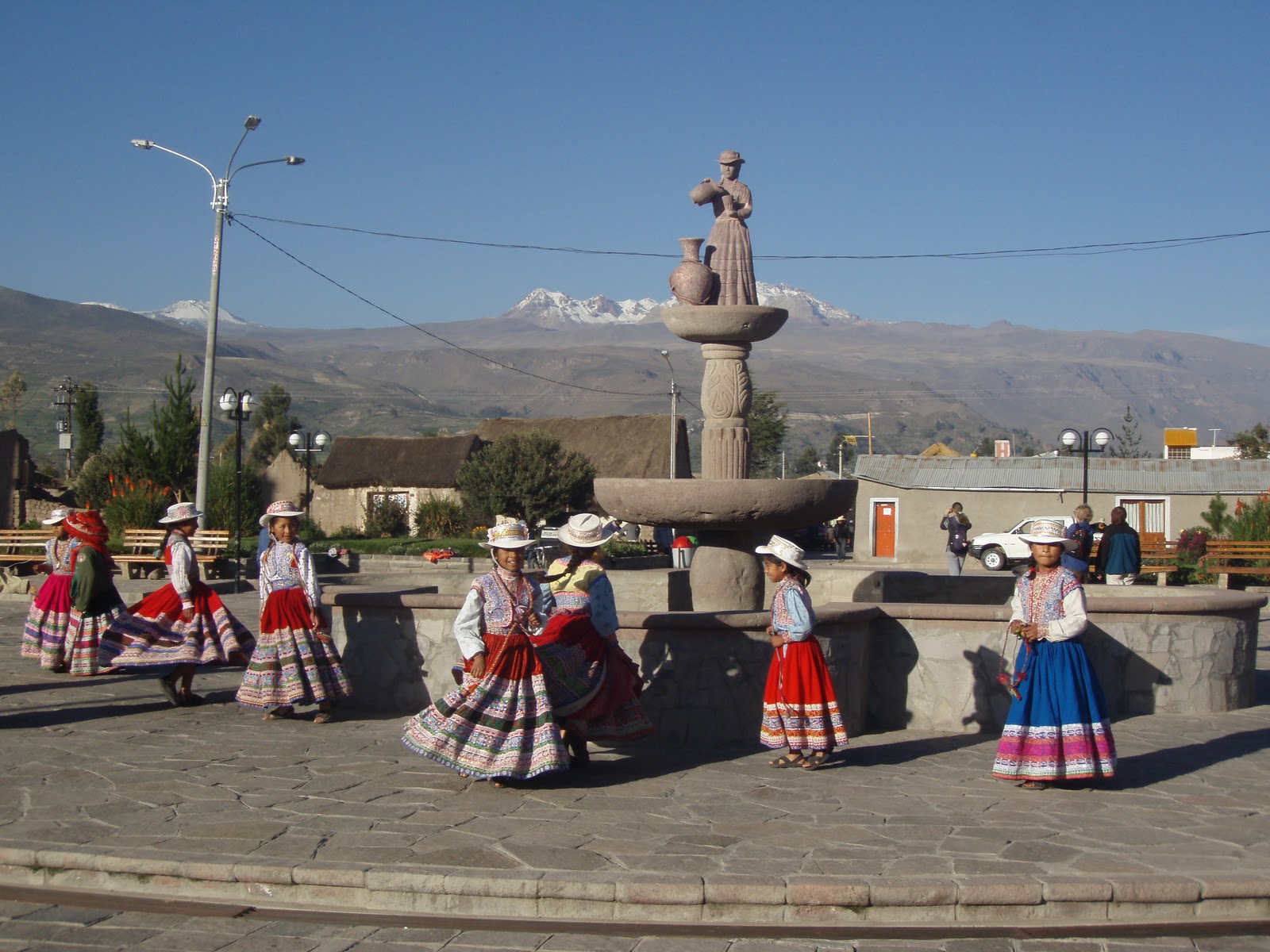
We stayed in Chivay, in the Colca region. These were school-girls who spend several 
hours each morning in January dancing roung the village square and fountain. 
The dances are a means of preserving stories of their Inca past.
History has it that the Spanish Conquistadores forced the men folk into nearby mines to dig for gold and kept them from their families. So the men tunneled their way back to the villages and when all the women suddenly appeared pregnant, the Spanish executed all the families - men women and children.
The Colca Valley - a rich and fertile area that the Incas acquired
from the previous occupants. They improved on the terracing and
irrigation to develop a much cherished agricultural region


The village market, Chivay

Volcano on route to Cusco